Choosing a portable power station for South African appliances
How to choose a portable power station in South Africa: 230 V 50 Hz output, SANS 164 sockets versus supplied outlets and adaptors, watt-hours versus watts, and start-up power.
A station rated 1,024 Wh gives roughly 7.8 hours at a steady 100 W under the assumptions below.
See why this fitsIllustrative runtime at a steady 100 W
usable Wh ÷ average W = hoursUse the row closest to your situation. The explanation below shows what can move the result.
Comparison table
| Nominal capacity | Usable energy (× 0.9 × 0.85) | Runtime at 100 W |
|---|---|---|
| 256 Wh | About 196 Wh | About 2.0 hours |
| 512 Wh | About 392 Wh | About 3.9 hours |
| 1,024 Wh | About 783 Wh | About 7.8 hours |
| 2,048 Wh | About 1,567 Wh | About 15.7 hours |
Planning estimate only. Real runtime varies with temperature, load behavior, battery condition and conversion path.

Use your own watts, hours and reserve.
A realistic input gives you a useful range instead of a false promise.
Open Power Planner →What does this mean
for your choice?
Watt-hours decide how long, watts decide what
Capacity in Wh is stored energy; output in W is how much power the inverter can deliver at once. The table multiplies capacity by 0.9 (10% unused reserve) and 0.85 (conversion losses) and divides by a 100 W load that already includes the station's idle draw. A station with a large battery can still have a small inverter, so read both numbers on the specification sheet of the exact model.
Check the AC output matches 230 V and 50 Hz
NRS 048-2 sets the standard low-voltage supply at 230 V phase to neutral and the standard frequency at 50 Hz. Many stations are sold in several regional versions with different output voltages, frequencies and sockets. Confirm the model you receive is the 230 V version and, if it has a frequency setting, that it is set to 50 Hz. A station designed for 120 V countries is not a substitute.
Sockets: SANS 164 and the adaptor problem
SABS describes the large round-pin SANS 164-1 plug as still in use and notes that since 2018 the wiring code requires SANS 164-2 socket-outlets in installations, with other configurations allowed on the same outlet. A power station may come with outlets for another country. SABS warns against plugging adaptors into one another, so prefer a station whose outlets fit your plugs directly or use one compliant adaptor, and never a chain of adaptors on a high-power appliance.
Start-up power for fridges and pumps
Motors and compressors draw a short surge when they start. Eskom's generator fact sheet notes that some refrigerators and air conditioners start at two or three times their running power. Check the station's surge rating against the appliance's start-up, or test the exact pairing, before relying on it in a power outage. See “Fridge, lights and phone during load shedding: runtime and start-up power” for a worked example.
Buying an imported unit
South Africa regulates many electrical products through compulsory specifications administered by the NRCS. Ask the seller which South African approvals apply to the exact model and keep the documents with the warranty. Compare models side by side in the product library and use “What size power station do you need during a power cut?” for the general sizing method.
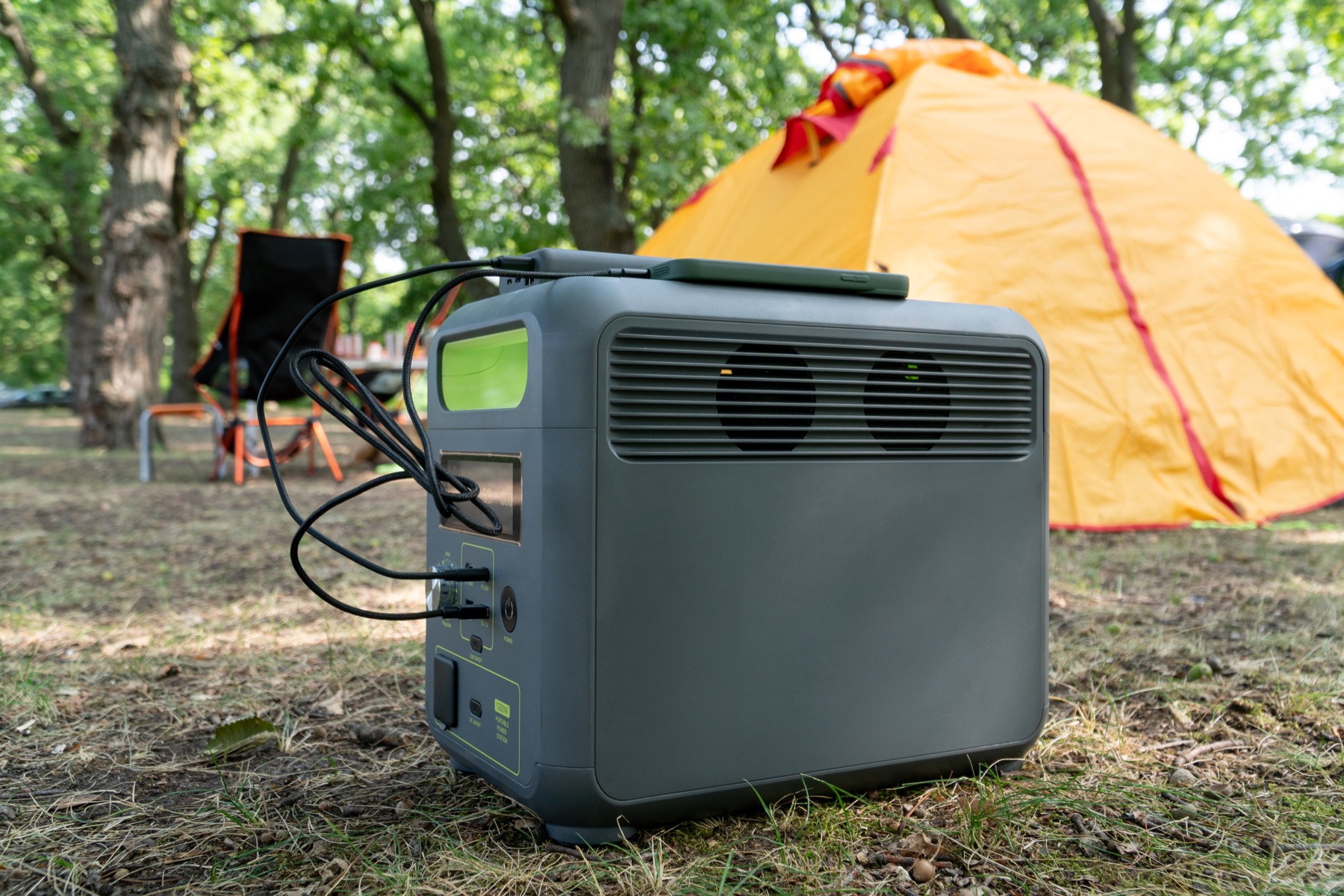
Check the complete power path.
A large enough battery can still be the wrong setup when its output, cable or regional version does not match.
- Capacity in Wh from your load list
- Continuous and surge output in W
- 230 V, 50 Hz output on the exact regional version
- Outlets that suit SANS 164 plugs without adaptor chains
- Seller's documentation for South African approvals and warranty
Practical answers
Can I use a power station bought for another country?
Only if its AC output is 230 V at 50 Hz and its outlets and plugs can be used safely. Check the rating plate and manual of the exact unit; a 120 V model is not suitable for South African 230 V appliances.
Are the runtimes in the table measured?
No. They are calculations using 85% efficiency, a 10% unused reserve and a steady 100 W load. Real runtime changes with the appliance, temperature and battery condition.
Evidence and sources5 official sourcesShow sources
Separate documented specifications from calculated matches.
Products lists stations documented on EcoFlow South Africa product pages beside source-region technical references. A calculated match is not a compatibility guarantee, a stock or price claim or a purchase recommendation. Enter your actual device load and check the sockets, lead and instructions of the exact unit.