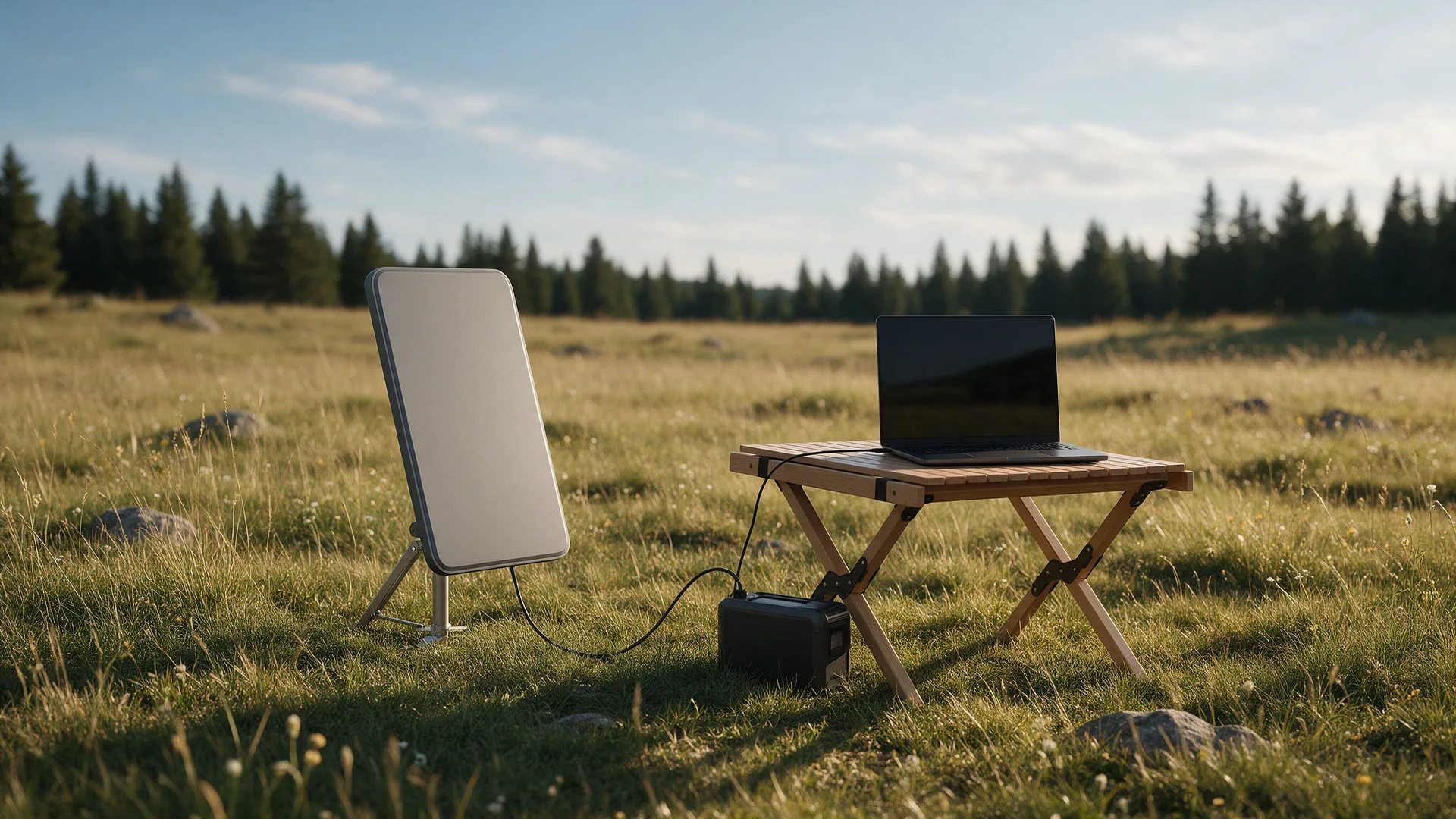
What the Mini needs
The Starlink Mini specification sheet used in this edition lists average consumption of 25–40 W. Actual use varies with temperature and activity. This is a battery-planning figure; local service availability and plan eligibility are separate checks.
The Mini itself has a DC barrel input for 12 to 48 volts, rated at 60 watts. Starlink only guarantees performance with the supplied power supply and cable.
Average use is not the USB profile
This is where it often goes wrong. An average of 30 watts sounds as if a 45 W charger would do. Starlink says otherwise: over USB-C you need a USB Power Delivery source rated at least 100 W (20 V/5 A). With 65 W or less, the Mini will not work.
For that you use the USB-C to barrel jack cable that Starlink offers. A USB-C cable in between also has to handle 5 amps: certified USB-C cables that can are marked 240 W.
A good spot
The Mini needs a clear view of the sky. Trees, a roof edge or a tall van next to you can interrupt the signal. Set it up away from overhanging branches and keep the cable free of doors and hinges.
The power station or power bank can sit in the shade, while only the Mini goes out into the open.
Test it at home
Connect everything at home once with the exact power bank or power station and cable you are taking. Does it start? Does it stay stable for half an hour? Then pack it all together.
Charge everything fully before you leave, and take the original power supply too if you expect a socket on site.
How long a power station lasts with the Mini is shown in the Starlink Mini power station guide.
Sources
Check exact specifications in manufacturer and standards documentation.