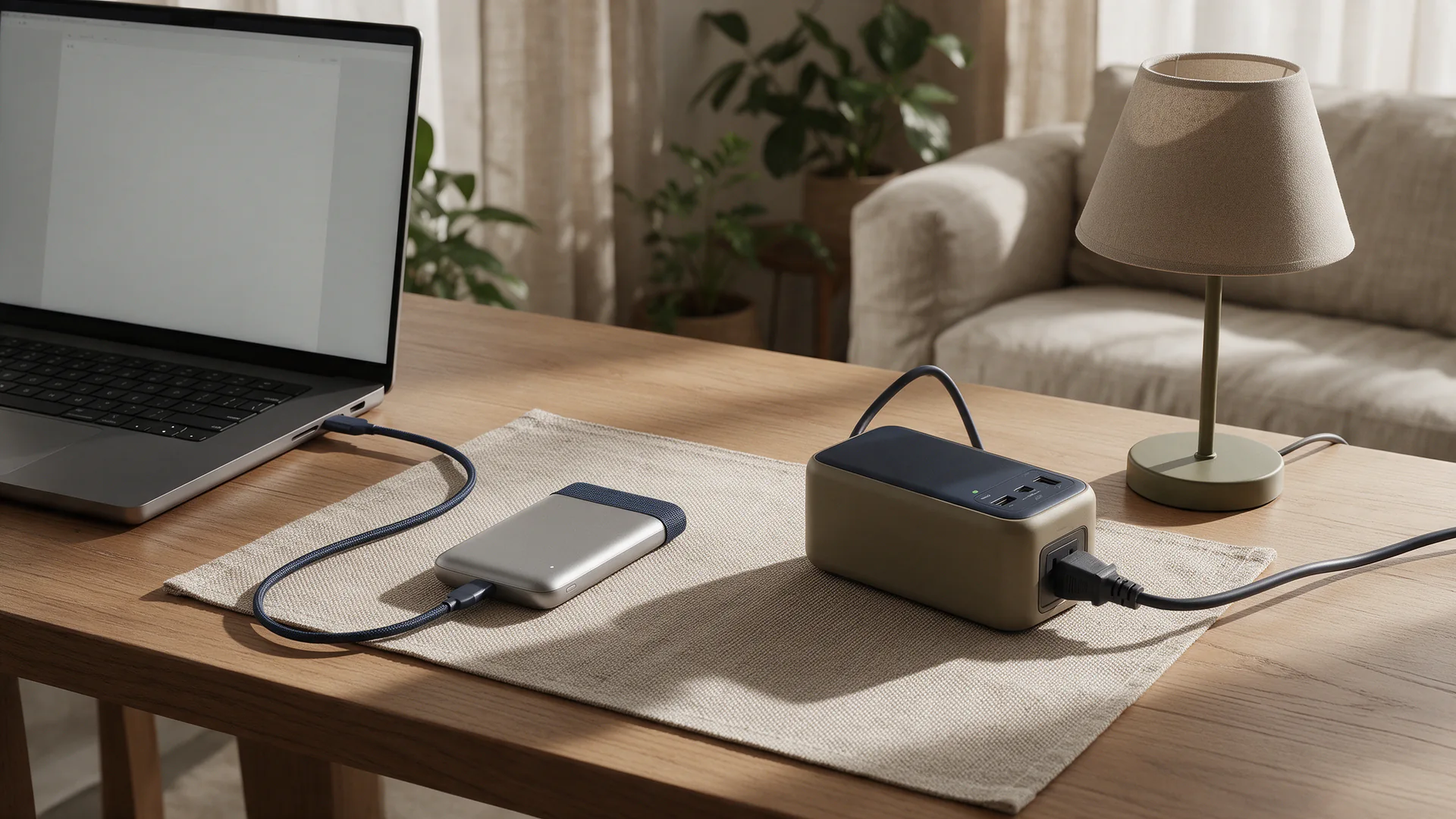
Look at the plug first
Phone, earbuds, e-reader, many laptops: they charge over USB-C. For those, a power bank is often all you need. It is light, quiet and goes in any bag.
A power station becomes useful when a device wants a normal power point. Think of a mains adapter you cannot replace, a lamp, a fan or a small fridge.
Two numbers, two questions
Watt-hours (Wh) say how much energy is in the battery: how long can it keep going? Watts (W) say how much power it can deliver at once: can it start the device at all?
A laptop that wants 65 W needs a power bank that can deliver that over USB-C. USB Power Delivery can go up to 240 W in the latest version, but only when the charger, cable and device all support it.
Also remember that not every watt-hour on the label reaches your device. Some energy is lost along the way, especially when a power station first converts it for its power point.
The cable counts too
Certified USB-C to USB-C cables are marked with 60 W or 240 W. A 60 W cable limits a fast laptop charger, even if the power bank can do more.
See the guide on power bank watts for laptops for the details.
When bigger really helps
Picture a day working in the garden: a laptop, a phone and headphones. A power bank with enough USB-C output covers that and stays in your bag.
Now picture a weekend with a laptop, a lamp on its own mains adapter and a small fridge. That is where a power station starts to make sense: several devices at once, power points, and days without charging.
Bigger does come with a price: more weight, more money and, via the power point, more conversion loss. For a phone and a laptop on a day trip, it is mostly extra luggage.
Sources
Technical claims checked against these sources on 28 September 2026.