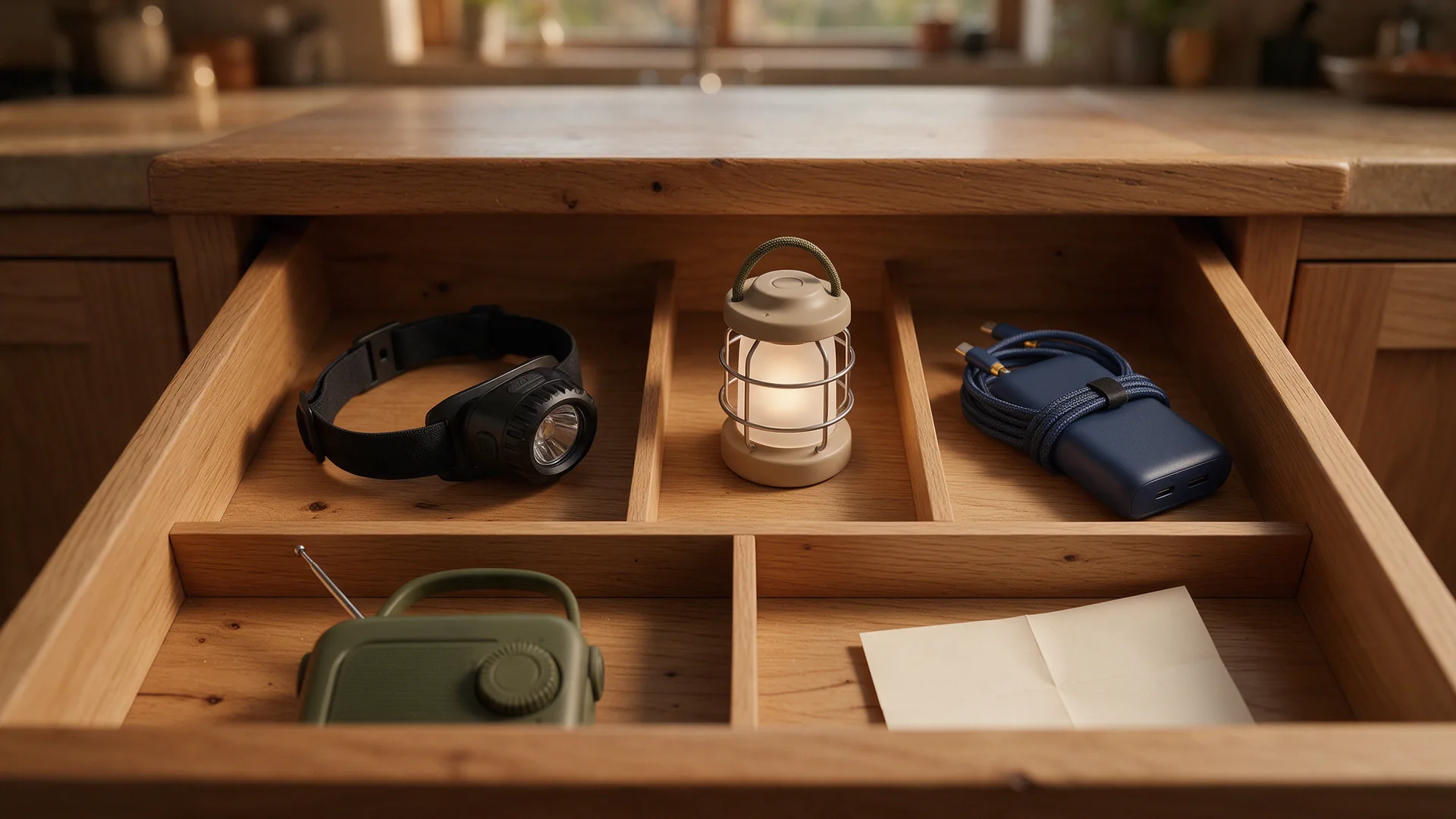
The drawer test
The lights go out on an ordinary Tuesday evening. Where is the torch? Which cable fits the power bank? If the answer is "somewhere", you already know what to fix.
Pick one drawer or box and make that the place. The aim is not to stock up for weeks, but to find the basics in the dark within a minute.
What goes in is short: a torch per person, spare batteries or a charging cable, a charged power bank, a way to get news and a note with important numbers. That is it.
Light first
Give everyone in the household a torch or head torch, and add a small lantern that lights a table. A head torch keeps both hands free for cooking, reading or finding the fuse box.
Batteries that fit, or a light you can recharge over USB, belong right next to it. Check them twice a year, for example at the start of summer and of winter.
A torch is also simply easier than candles: no open flame near curtains, children or pets, and it works straight away.
Keep the phone alive
Your phone is your torch, your radio and your contact list at the same time. A charged power bank with the right cable makes that last longer. Store it at a sensible charge and top it up now and then.
Switch the phone to low-power mode early and turn the screen brightness down. The phone saves energy, and you save stress.
Information without Wi-Fi
When the router goes dark, home Wi-Fi goes with it. Know how you will still get news: mobile data on a charged phone, a battery or wind-up radio, or both.
Add a paper note with a few important numbers and addresses. It needs no battery at all.
And when the power comes back? Power can return with brief surges, so switch off or unplug sensitive electronics while it is out and reconnect them calmly afterwards.
Want to go a step further? A power station can run more than a phone. How long depends on the device, and you can work that out with the runtime calculator.
Sources
Technical claims checked against these sources on 28 September 2026.